
Memory is the Altar
it's okay to forget because nothing is forgotten

It is summer in New York, a beautiful place and time where it feels like the whole world throbs with anticipation of Next Weekend’s Plans, a kingdom I gladly wall myself within and blur the shapes of the rest of the world, just as surely as I blur any knowledge that I ever once stepped outside these walls at all. As far as I’m concerned, most everything is always always. I am always dragging my body behind me in July, I am always waking up from dreams of people I haven’t seen in ten years or more, I am always in this tug of war between past and present. I have been sitting in the blistering heat of my room pouring over essays and images and becoming covered in paper-maché glue trying to understand how it is that I can call upon an ‘always’ whenever it feels convenient, and seemingly make them up as I go along, oftentimes believing there must be some objective truth about the person I’ve been that is less temperamental than the ‘always’ dictated by my current mood. Despite my hopes, I have let go of a definitive understanding of who I have ‘always’ been, what has ‘always’ been true, because the past is not meant to be easily legible.
In the book The Spell of the Sensuous, author David Abram writes about Aboriginal Australian notions of the Alcheringa (Dreamtime) and the Distant Time of the Koyukon, both cultures who locate the past not as a specific temporal point which is finished and concretized, but is more accurately “a depth of the experiential present.” It is always changing and relating to us more in a spatial sense than in a temporal sense, more accurately described as being akin to the rich soil we stand on as opposed to a far point in the distances at our backs. Memories are meant to decompose and transform, aging and rotting and fertilizing new life, rather than be pinned behind glass like some macabre taxidermied thing. This understanding of the past feels intuitive to me— if we were to locate the past in space, it would not be a place we could travel to. It would be a place that is out of sight but is nevertheless the groundwork of our surroundings, certain to lay beneath us but concealed in its appearance, known only in the shapes of what grows from it.
In one of my favorite essays on the planet, author Jackie Wang writes about the power of the future anterior tense (will have) and the alchemizing power of making our present into past, illustrating how fluid creation and narrativization are. Like casting a spell, a person can decide at any moment to create the truth of what a moment will become—I will have written this paper, this will have been a time of learning, my scar will have reminded me of my adventures. Rightly, she ascribes this linguistic device a spiritual level of import, noting that the future anterior has pulled her from some of the darkest trenches of her life, offering an outstretched hand from a not-yet-born but surely-conceived self, like mountains on the horizon that you can turn your head towards and start walking to. Someday this, too, will die and rot beneath the roots of new life. The past is already, forcefully, magically being laid to rest with every breath, often unnamed in power but nevertheless reaping as it goes, and we, too, are holding the scythe.
I would not consider myself someone who is stuck in the past, and yet all the same it feels like contemporary technology and culture emphasizes gripping to the past in a way that one can’t help but be consumed by. Here in america, there is literally a country-wide majority championing to make america great again, as if return has ever been possible both philosophically or literally—no man steps into the same river twice and all that—but beyond this most explicit call for “the past,” I also find myself disturbed by the more clandestine ways this fixed and lifeless understanding of the past creeps into the corners of our lives, slowly making us all victims of linearity. Instead of an embodied understanding of the constantly changing past inevitably weaving into this very present moment, instead of understanding the inextricablity of this changing past to the changing future, more and more I find that people seem to campaign for some ultimate truth of the past, which in my assessment could only ever be bare and deep like bedrock, still unable to completely reveal all the layers of earth hold us up.
In the most obvious use of this sterilized and rigid way of thinking, we try to establish “the facts of our lives,” from something as simple as “I played chess” to something as complicated as “I was hurt.” We cling to them like lifeboats, using these repetitious stories of where our egos have been to justify who we are now, not only calcifying the infinite expanse of our past selves, but also the absolute mystery of our present beings. In many dharma talks, Lamas and Roshis will expound on the profundity of “no-self” and the liberatory awakening that comes with letting go of who we believe ourselves to be. After all, it is harder to hold onto all these supposed certainties than it is to release our grip.
I am interested in the way this intersects with the art of making oneself, which Joan Didion so insightfully wrestles with in her essay On Keeping a Notebook. “Perhaps it never did snow that August in Vermont; perhaps there never were flurries in the night wind, and maybe no one else felt the ground hardening and summer already dead even as we pretended to bask in it, but that was how it felt to me, and it might as well have snowed, could have snowed, did snow.” What is the point of clinging to the decided facts of the past if those facts serve to flatten one’s experience? I find myself in agreement with Joan, that it did snow because she felt it snowed, and also that maybe tomorrow something could happen that would make it so that it decidedly did not snow in her Vermont August. Recently, a friend broke my trust quite suddenly, and immediately I was able to pour over the history of our relationship and find evidence that foreshadowed this surprising turn, knowing all the while that if the opposite had happened, then I just as easily do the same for all the times my trust has been earned. Feelings never understand things the same way in one moment as they do in the next, and I am not naive enough to ask them to.
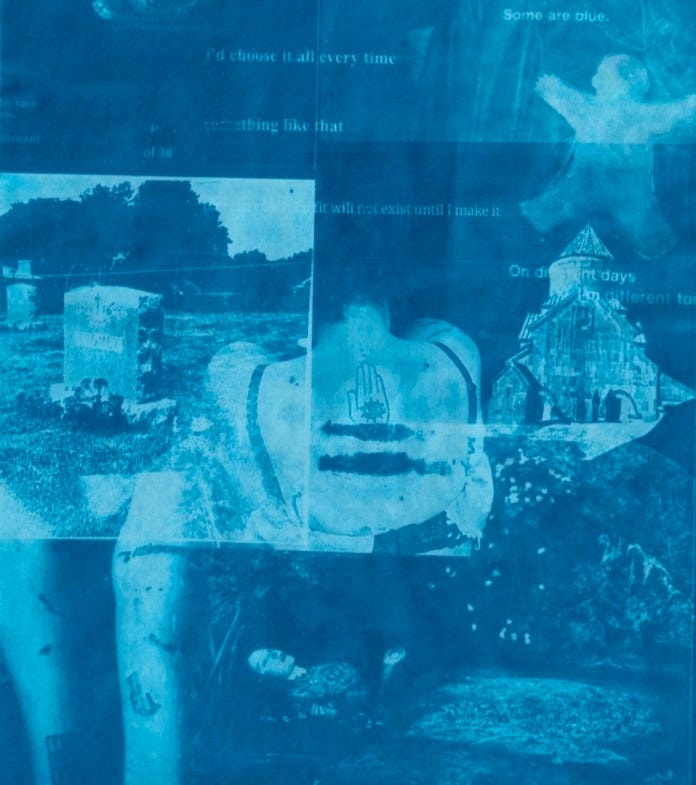
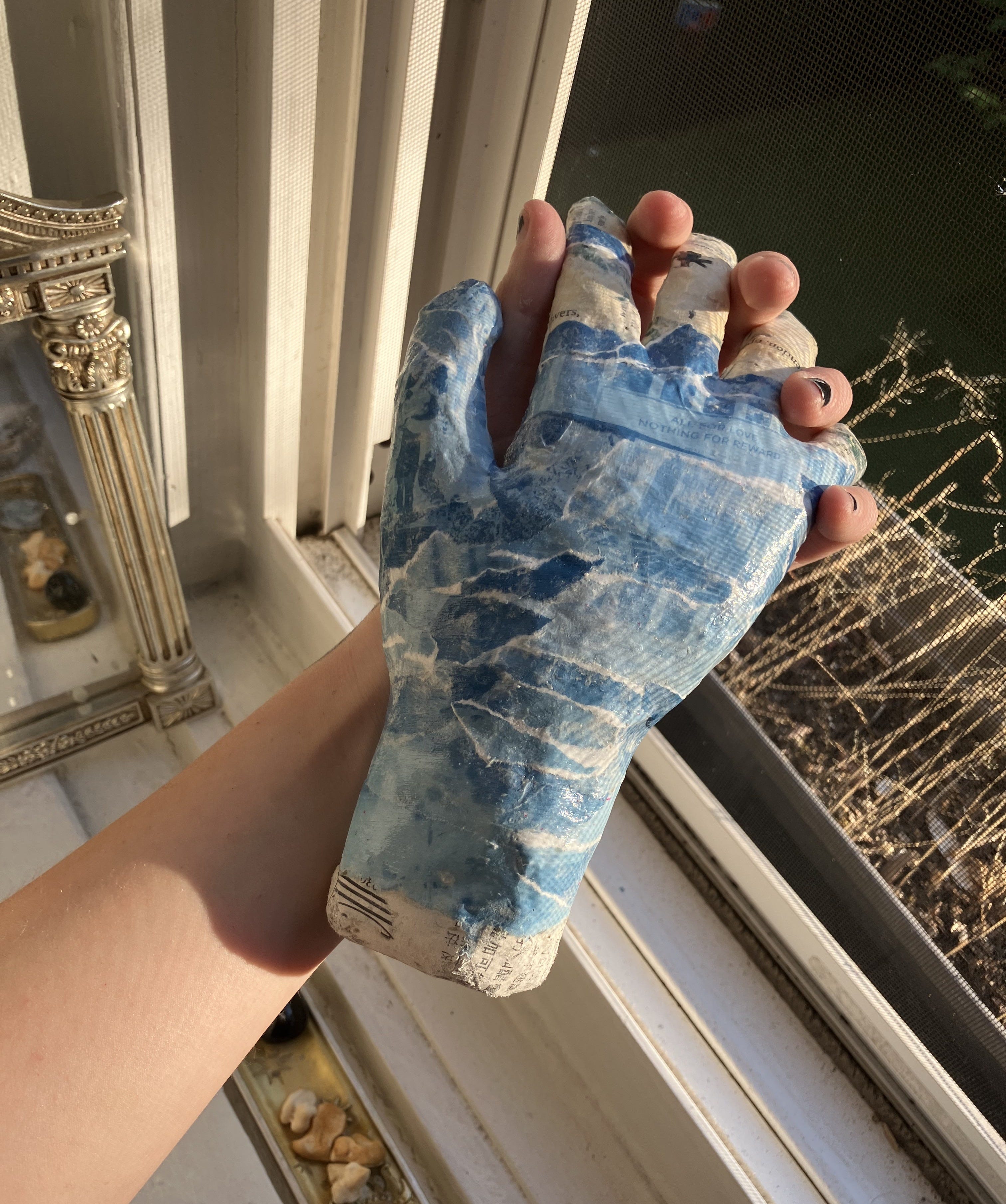
As I write this, I do so in a room that is filled with floating sculptures of sun-printed memories of my past. Quotes that have built me as much as the people I’ve held, developed under the temperamental light of the sun and formed into shapes that they have always taken in my mind. For my whole life, I have always dreamt of whales, of floating down into the black of the ocean, holding onto their massive spines as they dove. Equally a memory, now the facts of my life have assumed the shapes of these beasts, blurring the boundaries of what has formed me across the realms of historical fact and embodied experience. In this same vein, I also made a massive three foot tall hand coated with these watery images, because that is how big I remember an adult hand was when I was a baby. It might as well have been, because that’s what it felt like.
In this sea of memory/non-memory I’ve been surrounded by in the sweltering heat of my twenty-sixth summer, I have been curious about the ways that identifying with memory has stunted the natural process of change. I want to allow my memories the dignity of death, and all the while something unshakable has been breathing down my neck like a stalking night-creature. Every day I was confronted by it, it’s taloned grip on my shoulder reminding me of the inescapable tower I had constructed for myself. Rearing it’s blood-soaked grin, I finally sat down to address it…my iPhone camera roll.
Out of almost 20,000 photos from the last ten years, there were maybe only 500 that I would feel precious enough about to print and hang on a wall. One of my friends, now seventy two, has about three photos of himself from his whole life (child, adolescent, adult), and I find that beautiful. Conversely, I find it vaguely disturbing that I am able to look back in so many angles and lightings at what my teenage body looked like, or screenshots of a text fight from two years ago. The number on my camera roll felt like a weight that was dragging me away from the present, and reminded me all-too-closely of when I worked in a graveyard, being told that a grave would likely stop being tended to by family members about twenty years after the person’s passing. A grave–the enduring symbol of the entirety of a person’s life– maybe revisited for twenty years. Three generations if the person was famous. So I asked myself, who are all these relics for? And what is it doing to my heart to maintain this ambient psychic grip?
I decided to print out a hundred photos from each year, an amount that seems like a generous number, and to clear out the rest (of course barring the exception of any particularly superb memes). I realized I didn’t actually care all that much if I looked amazing in a selfie from three years ago, and that holding onto that selfie felt, in a way, bizarre. I realized that I didn’t actually care that I don’t have that many photos of my childhood. I realized that my stories of the events of the past ten years, changing with each retelling, a part emphasized for effect or a bit of dialogue improvised, would become replaced overtime with what I had taken a photo of, and that many of my most cherished moments had no visual counterpart. Like my dreams or my feelings, the things of my life that I have no evidence for are the things that have made me the most. It felt like a psychic purging that was long overdue, like a sobering reminder of the passage of life and the glory of the overwhelming truth of the present.
Like anyone who has ever done a psychedelic in the age of smartphones, the spiritual bastardization of life that is the iPhone can occasionally fall down on you like an absurd joke. In the midst of this purge, I was glad to see that the much needed (albeit heavy-handed) activities of the Luddite Teens are still going strong in a week-long festival in Tompkins Square park, where they only have two rules, Be present and Absolutely No Phones/Photos/Recording allowed. Although I’m not entirely sold on a full-on “Summer of Ludd,” I am ready to release my digital nostalgia in favor of mediums that I find to be more sustainably memory-cherishing and past-honoring. Burning a few CDs of all-time classic playlists (something I got a taste of when moving only five playlists over from Spotify when I switched to TIDAL) and printing out the photos I would want to show grandkids and scrapping mostly all the rest (the amount of exes in my camera roll alone felt like a pixelated prison)— there is a comfort is being able to handle the physical dimensions of the past like a box of letters as opposed to the unknown weight and size of the data centers and memory-cards that hold all my outsourced remembering. We are meant to forget the details, we are meant to be able to unearth our pasts as the present sees fit.
In Toni Morrison’s essay “The Site of Memory,” she insists that “the act of imagination is bound up in memory,” confessing that she could not actually tell you how she felt when her father died, but she could imagine it through writing out a similar scene, and thus access something truer to that memory than actual knowledge of her initial, locked-in-time feelings. Like Abram, she honors the presence of the past by referring to it as “the substrata” of her work, clearly calling upon it’s foundational aspects while also acknowledging a hidden and mysterious nature therein. She goes on to liken memory to water, flooding back to the original source through the sensations it encounters while traveling– a dip in the valley, a sandy shore. “All water has a perfect memory,” in the same way of that Buddhist koan about each of our lives being like a droplet of water briefly splashed out of the ocean, fooled into individuality before falling back down into the wave, an infinite play of forgetting and remembering.
There’s something undeniably spiritual in the way we form memories and conceive of the past, and loosening the grip can allow us to more fully show up for who the present is asking us to mold into. The ocean will remember, my phone storage will not. The painting will be repainted over one million times.
How lucky am I to have gotten to talk about this more the next time I will have seen you!! And to have already been able to hear you chew through some of these ideas
Summer of Ludd sounds enticing!
Great essay. Incredible how memories shift and take on new life through fresh experience. Sometimes it does feel like time can be reversed, with causes and effects swapping roles for a spell…